Clothing rental · Future of travel
We Stopped Owning Almost Everything. Except What We Pack.
Music, movies, rides, even the suit for a wedding: we moved from owning to accessing. Travel is the one place we still carry everything.

By Mathias Nana · 4 min read ·
Think about your phone for a second.
It holds millions of songs, and you own none of them. Your TV plays almost any movie you want, and there is no shelf of DVDs under it anymore. When you need a ride in a big city, you tap a screen and a car arrives a few minutes later.
Now think about the last time you packed for a trip.
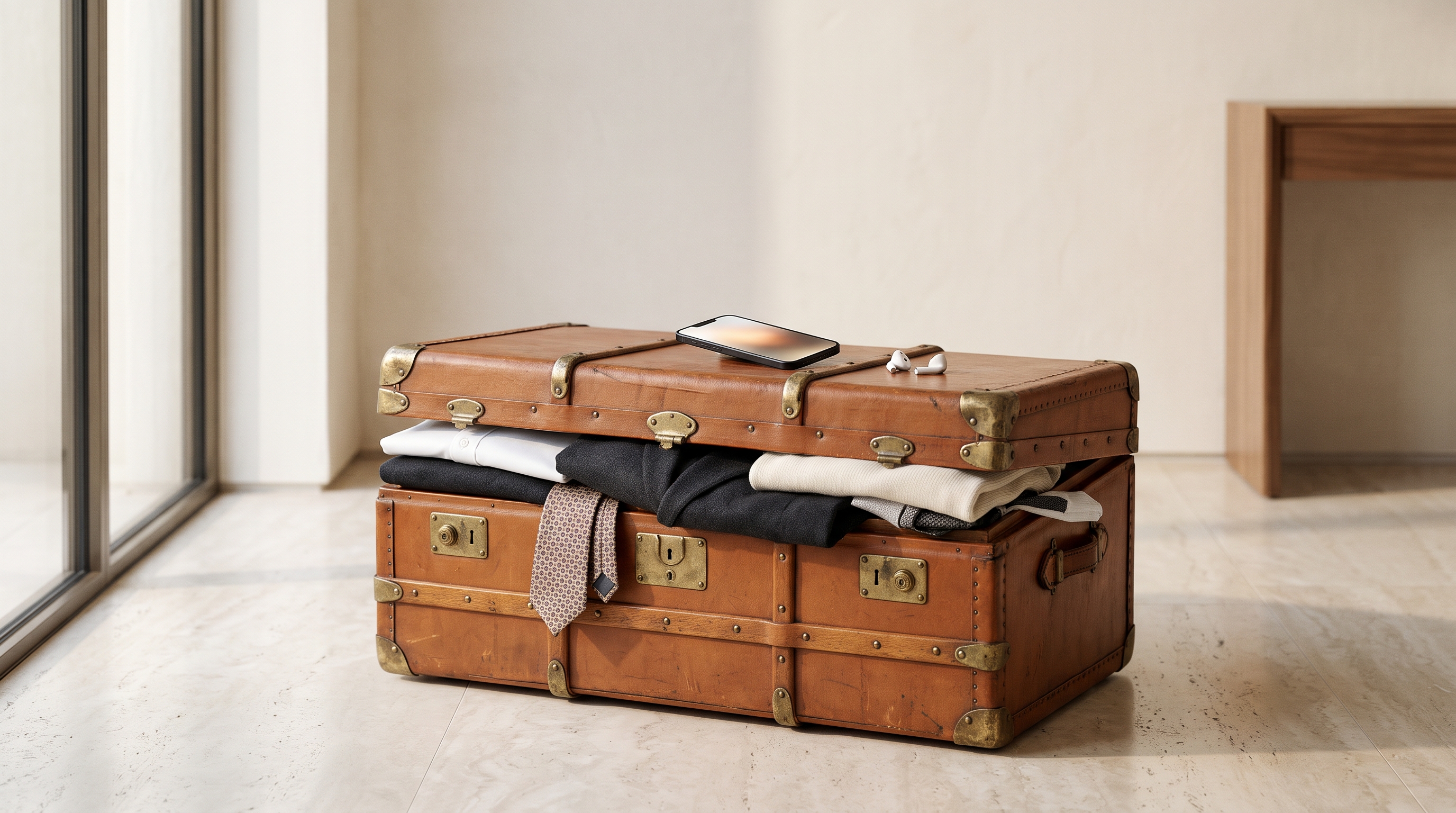
You probably stood over an open suitcase, deciding which shirts to bring, then pressed the lid down with your knee to close it. Maybe you sat on it.
Same person. Same year. Two very different ways of living.
The quiet shift
Over the last twenty years, something changed in how we live, and most of us did not notice it happening.
We stopped owning music. We stream it. We stopped owning movies. We press play. In many cities, we no longer need to own a car. We use one when we need it, and then we let it go.
Researchers have a name for this. They call it access-based consumption: we pay to use something, not to own it. The idea is not new. Back in 2000, Jeremy Rifkin called it The Age of Access. In 2012, Fleura Bardhi and Giana Eckhardt studied people who use car sharing and found that access changes our relationship with things. We care less about having them, and more about having them when we need them.
That is the shift. Ownership used to be the default. Now, for more and more of our lives, access is.
Even clothes made the jump
You might think clothes are different. Clothes feel personal. They carry our style, our size, our story.
But look at how many people dress for a wedding or a gala. They rent the suit. They rent the dress. They wear it once, look their best, and give it back. Nobody feels they lost something. Most feel they gained something: a better outfit than they would have bought, and no closet full of clothes they will never wear again.
So the idea of wearing something that is not yours, for one important moment, is already normal. We just do not apply it everywhere yet.
Then we travel, and we go back to 1850
I find this strange! The moment we plan a trip, all that progress disappears. We go back to owning, and carrying, everything.
We pack. We check the bag. We wait at the carousel and hope it shows up (if you know, you know). We drag it to the hotel. We unpack.
A few days later, we do it all again in reverse. Pack. Check. Wait. Drag. Unpack.
Every trip. The same cycle.
In the 1850s, rich travelers crossed the world with huge trunks, and their whole wardrobe came with them. Today the plane is faster, safer and smarter than anything they could imagine. But the idea behind the suitcase has barely changed. We added wheels. We added a handle. That is about it.
I live this too. My whole wardrobe has fit in one bag since 2019. And I still pack it, check it, wait for it and drag it, every single trip.
Why hasn't travel changed?
If access works for music, movies, cars and even wedding suits, why not for travel? I see three reasons.
- First, nobody owns the problem. Airlines carry the bag. Fashion brands sell the clothes. Hotels host the guest. The suitcase sits in the space between all three, so no single industry sees it as its job to fix.
- Second, habit is strong. Packing feels like control. When your clothes are with you, you know where they are. Letting go of that feels risky, even when the old way is tiring.
- Third, and most important, trust. Will it fit? Is it clean? Will it actually be there when I land? These are fair questions. Any new way of traveling has to answer them honestly before anyone will try it.
I do not think these barriers are small. But I also do not think they are permanent. Every shift from owning to accessing faced the same doubts at first. Would people trust a stranger's car, a person delivering foods? Would they give up their music collection? Many did, once the new way became easier than the old one.
We moved from owning to accessing. Travel is the last place we still carry everything.
What my research asks
This is the question at the center of my doctoral research: what if your clothes did not travel with you?
Imagine landing in a new city with only a small bag. A wardrobe curated for your size, your style and your trip is already waiting for you. Outfits chosen for your meetings, your dinner, the wedding on Saturday. When the trip ends, you give it back, and someone else takes care of it.
I am not saying this is the answer. I am evaluating whether it can be, and what it would take for travelers to trust it. That is what research is for: testing an idea honestly, including the parts that might not work.
We changed how we live
We changed how we listen. We changed how we watch. We changed how we eat. We changed how we move around our cities.
Maybe it is time we change how we pack when we travel.
So I would like to ask you: what would you need to trust a curated wardrobe that is waiting for you when you land?
Tell me. Your answer helps shape the research.
Watch the video: We stopped owning everything. Except when we travel
References
- Bardhi, F., & Eckhardt, G. M. (2012). Access-based consumption: The case of car sharing. Journal of Consumer Research, 39(4), 881–898.
- Rifkin, J. (2000). The age of access: The new culture of hypercapitalism, where all of life is a paid-for experience. Tarcher/Putnam.