Sustainable travel · Airline economics · Clothing rental
The 27 Kilos: What Your Checked Bag Really Costs the Planet
Skip the checked bag on a New York to London round trip, rent your clothes when you land, and you save about 27 kilos of carbon. Here is the math, where it stops working, and why your airline's carbon number will never show it.

By Mathias Nana · 5 min read ·
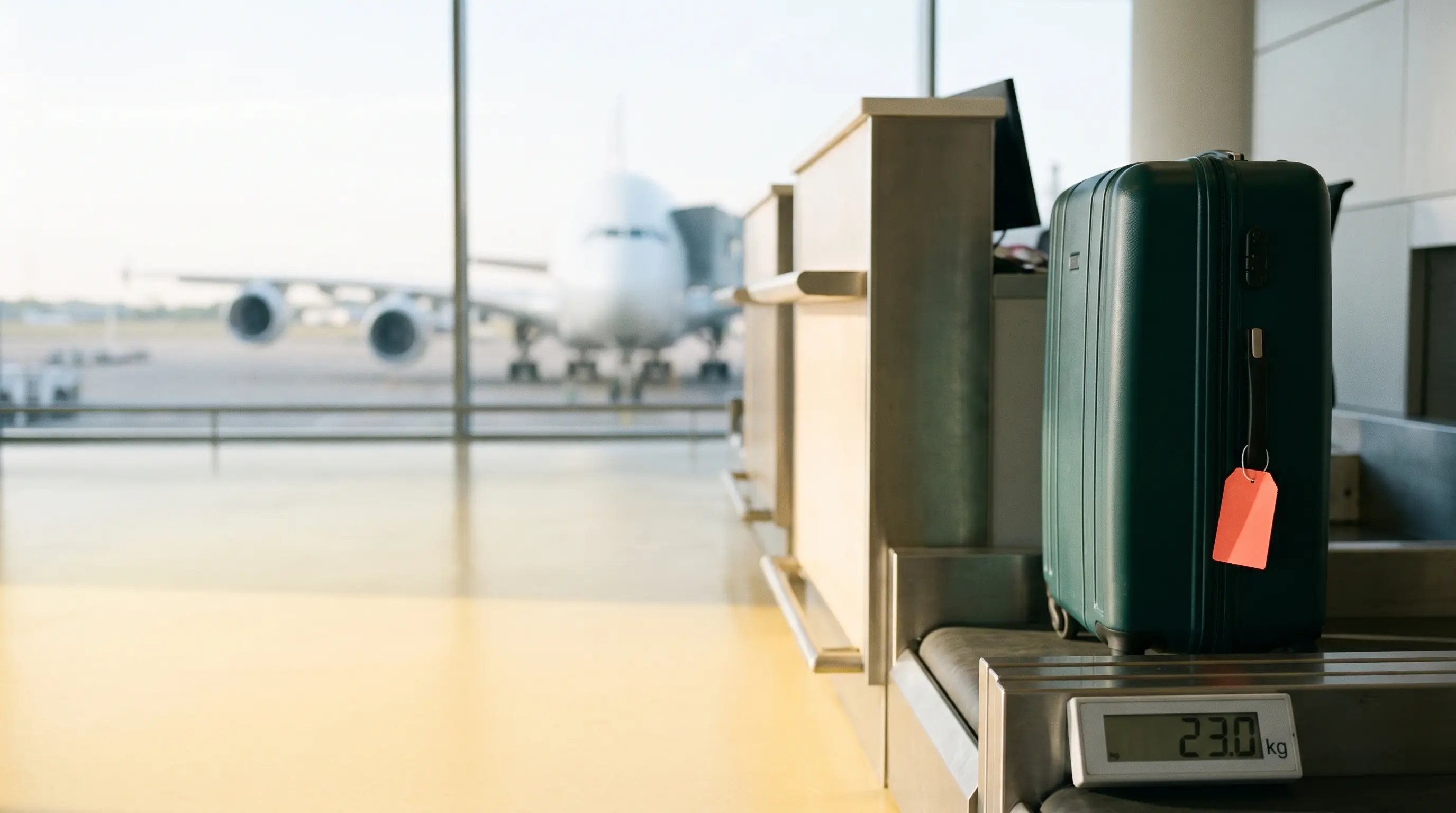
5 years ago, I started my doctorate because of a frustration I had at Pudong airport in Shanghai. I had landed for class, my 2 checked bags had not, and the shops were already closed. My clothes arrived 4 days later. At the time, I thought I was solving a convenience problem: how to make air travel easier for the people who fly.
Then I learned how the physics work on a plane, and the problem got bigger.
What Does a Checked Bag Do to a Plane?
A plane burns fuel to carry weight. The more it carries, the more fuel it needs, and every kilo of fuel it burns turns into carbon. That relationship is not a rule of thumb. Engineers who model aircraft fuel use show that, across normal flight conditions, each extra kilo of payload adds a proportional amount of fuel burn, and the effect grows with distance.
Your checked bag is part of that payload. So is everything inside it: the extra pair of shoes, the jacket for weather that never came, the outfit you packed just in case. You pay to check it, you carry it, you drag it, and the plane burns fuel to fly it there and back.
So I asked a simple question. If you left that bag at home and rented your clothes at your destination instead, what would actually change?
Where Do the 27 Kilos Come From?
Take a New York to London round trip in economy. The numbers come from the carbon model I built for my research, which compares 2 versions of the same trip: a version with a checked bag, and a version without it, with clothes rented at destination.
- The bag: a checked bag at the standard economy allowance weighs about 23 kilos.
- The distance: New York to London and back is about 11,000 kilometers.
- The flight cost of the bag: each kilo flown 1 kilometer adds about 0.12 grams of CO2e. Over 11,000 kilometers, 23 kilos adds up to about 30 kilos of CO2e, just for that bag.
- The cost of renting: renting clothes is not free for the planet either. Delivery, cleaning and the clothes themselves all carry a footprint. For 3 outfits, that comes to about 3.5 kilos of CO2e.
- The result: take the 3.5 kilos away from the 30 kilos your bag would have cost. You still save about 27 kilos of CO2e on that trip.
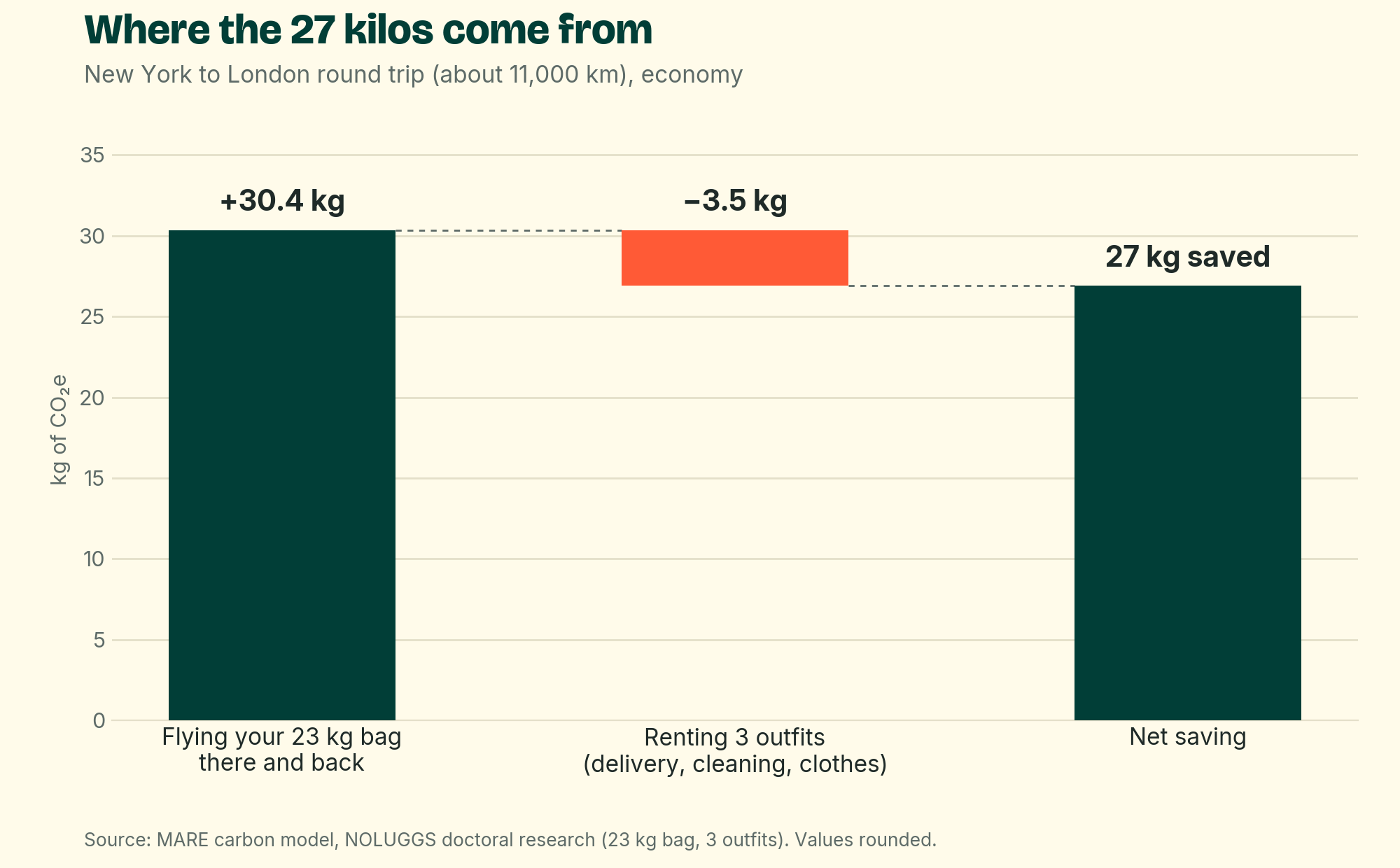
The second line matters as much as the first. Many claims about travel and carbon count only what you avoid and ignore what you add. The model counts both, because a saving that ignores the cost of the alternative is not a saving.
When Does Leaving the Bag Stop Paying Off?
This is not true on every trip.
- Short trips: the saving from the flight grows with distance, but the cost of renting does not. Below about 1,200 kilometers round trip, with 3 outfits in economy, renting emits more than flying your bag. On a short hop, keep your bag if you are sensitive to your carbon footprint.
- Carry-on only travelers: if you already fly with a cabin bag only, there is no checked bag to remove. Renting clothes then adds about 3.5 kilos and saves nothing in the air.
- What the model leaves out: it counts carbon dioxide from burning fuel and the footprint of the rental. It does not include the extra warming effects of flying at altitude, such as contrails, does not count the carbon footprint generated by the baggage system at the airport, and it does not count the clothes you might stop buying over time.
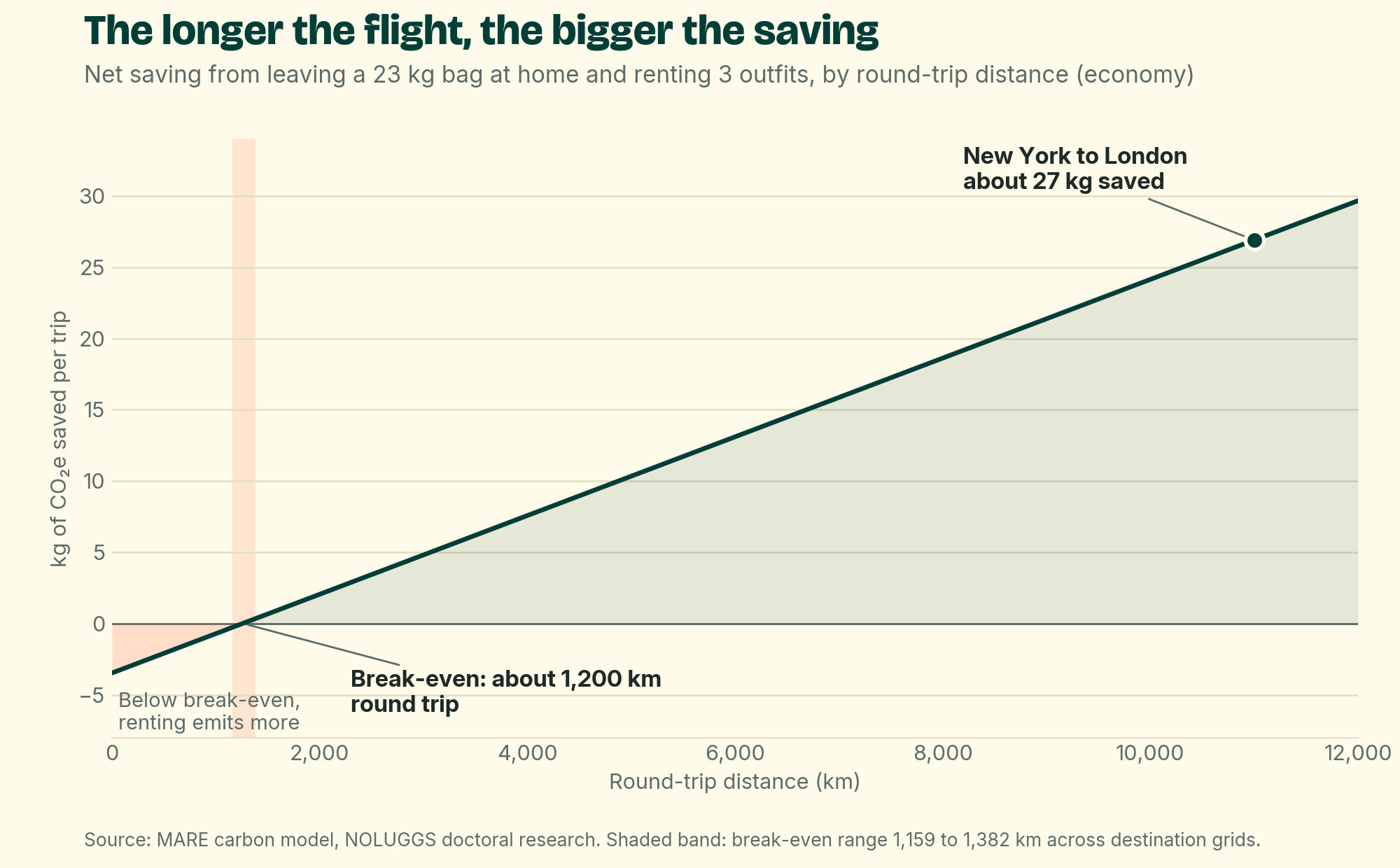
Within those limits, the result holds where it matters most: on the long-haul flights that frequent travelers take again and again.
Why Will Your Airline Never Show You This Number?
When you book a flight today, you can often see its carbon footprint. But there is a catch.
The industry standard for these figures, published by the International Air Transport Association (IATA), lets airlines count every passenger at a standard value of 100 kilos, passenger and checked baggage together, when they do not use their own weight data. The International Civil Aviation Organization's (ICAO) calculator works the same way: each passenger is assigned a standard weight that already includes baggage.
That is a reasonable way to split a whole flight's emissions across everyone on board. It is also why your choice disappears. Whether you check a 23 kilo bag or no bag at all, your weight on paper stays the same, and so does your carbon number. These calculators answer a different question: how much of this flight is yours on average? They do not ask what changes because of what you packed.
NOLUGGS counts it differently. It looks at the variable you actually control on your trip: the bag you leave at home and the clothes you rent at your destination. That is where the 27 kilos come from.
After all, this is an accounting difference. Whether the weight travelers leave at home shows up in an airline's actual fuel bill depends on how airlines plan and load their flights, and that is a question for further research.
What Does This Mean for Your Next Trip?
Next time you see your flight's carbon number, ask yourself: does it actually know what I packed?
On a long flight, the lightest bag is the one you never check. I am building and testing a way to make that easy: a curated wardrobe that fits you, waiting at your destination. In my next video and article, I will share what happened when I tested it with about 200 travelers, and why almost none of them did it for the planet.
Mathias Nana Doctoral Researcher
Sources
- International Air Transport Association. (2022). IATA Recommended Practice RP 1726: Passenger CO2 calculation methodology (Section 2.3.1, standard passenger weight). iata.org
- International Civil Aviation Organization. (2024). ICAO carbon emissions calculator methodology (Version 13.1). icec.icao.int
- Poll, D. I. A., & Schumann, U. (2021a, 2021b). Physics-based estimation of aircraft fuel burn. The Aeronautical Journal.
- Turgut, E. T. (2017). Operational data analysis of non-payload weight effects on aircraft fuel consumption.
- Model values: MARE carbon model, NOLUGGS doctoral research (economy, 23 kg bag, 3 outfits, New York to London round trip of about 11,000 km; net saving 26.90 kg CO2e; break-even 1,159 to 1,382 km round trip).