Future of travel · Clothing rental · Sustainable travel · Lost luggage
By 2040, Packing Your Clothes Will Feel as Dated as a Nokia 3310
Convenience, rental and climate pressure are converging on one of travel's oldest habits. Within 15 years, flying your wardrobe across the world will look absurd.
By Mathias Nana ·
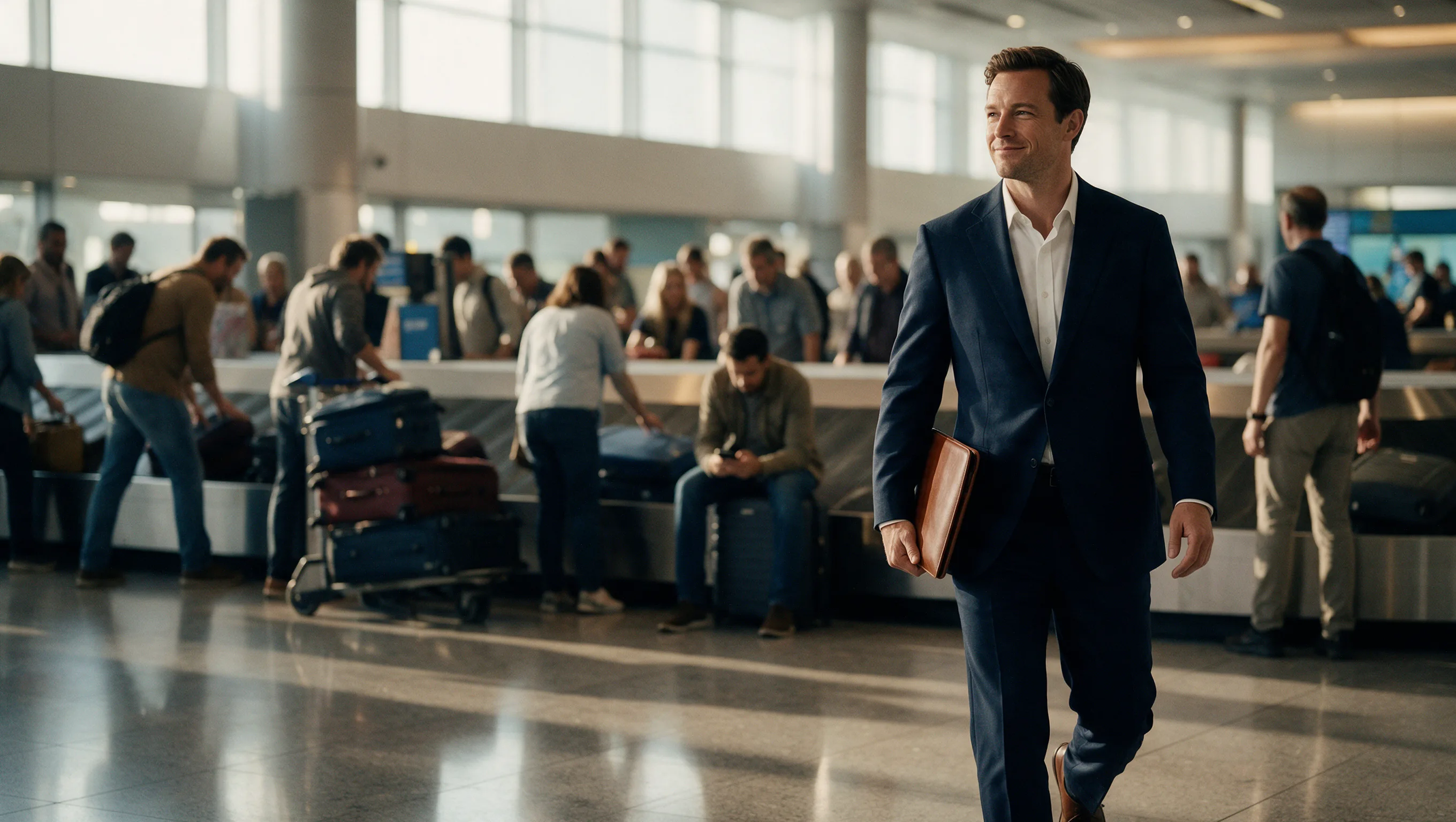
In 2019, I landed in Shanghai for the final module of my MBA, and both of my bags did not. By the time I reached the city, every shop was closed, and I had class the next morning with nothing to wear. I had flown two full suitcases across the world, while a city full of exactly what I needed sat behind locked doors.
It is tempting to call that bad luck. It is not. It is what happens when a 21st-century travel system still moves our clothes as if it were the age of the steamer trunk. We book flights on our phones, board with a code on our wrists and stream films at 35,000 feet. Then we fold our wardrobe into a box, hand it to a stranger and hope it comes back.
That habit will not survive. By 2040, packing your clothes for a trip will feel as dated as using a Nokia 3310 does today. No one will ban the suitcase. Three forces are simply making it unnecessary: our demand for convenience, the rise of clothing rental, and the mounting pressure to make travel cleaner.
Travelers are already voting against the bag
Start with money, because travelers do. U.S. airlines collected $7.4 billion in baggage fees in 2025, according to the Bureau of Transportation Statistics. Passengers have responded the way people respond to any toll: they look for a way around it. In a 2025 survey commissioned by LugLess, a luggage-shipping company, 71 percent of Americans said they now avoid checking bags, and a third admitted to wearing extra layers to dodge the fee. The sponsor has an interest, but anyone who has watched passengers wrestle bulging carry-ons into overhead bins knows the direction is real.
The bags that do get checked still fail at scale. SITA, which tracks the industry's baggage systems, counted 33.4 million mishandled bags in 2024, at a cost of about $5 billion. And that was one of the better years on record.
History shows what happens when a clearly easier option appears. In 2011, 35 percent of American adults owned a smartphone. By 2025, Pew Research Center put the figure at 91 percent. That took fourteen years, exactly the distance between today and 2040.
Skipping the bag, however, only works if your clothes can come from somewhere else. That is where the second force comes in.
We no longer need to own what we wear
For most of history, owning clothes was the only way to wear them. That assumption is cracking. Grand View Research expects the online clothing rental market to reach $2.33 billion by 2030, growing about 8.5 percent a year. Part of the appetite comes from a quiet inefficiency in our closets: according to the Ellen MacArthur Foundation, the number of times a garment is worn before it is thrown away fell by 36 percent between 2000 and 2015. We own more, and we wear less.
Travel is where rental makes the most sense, and the industry has noticed. In July 2023, Japan Airlines and Sumitomo Corporation began testing "Any Wear, Anywhere," a service that lets visitors to Japan rent clothes that wait at their hotel and return them before flying home. A year later, the partners extended the trial, widened the size range and added children's clothing. When a major airline starts putting rented clothes in hotel rooms, the idea is no longer a thought experiment.
Convenience and rental could change the habit on their own. The third force makes the change urgent.
The pressure to fly cleaner is rising, even as travelers tire of hearing it
Aviation produced about 2.5 percent of global carbon dioxide emissions in 2019 and has contributed around 4 percent of global warming to date, according to Our World in Data. Regulators are no longer waiting. Under the European Union's ReFuelEU Aviation rules, sustainable aviation fuel must make up 2 percent of the fuel supplied at EU airports from 2025, rising to 70 percent by 2050.
Travelers, though, are growing weary. In Booking.com's 2024 survey of 31,000 people in 34 countries and territories, a third said they were tired of hearing about climate change, and nearly half said sustainable travel matters to them but is not a primary consideration. That may be the most important lesson for anyone hoping to change how we travel: guilt does not scale, but convenience does. A plane that carries less weight burns less fuel. A habit that drops the bag because it is easier also moves travel in a cleaner direction, without asking anyone to sacrifice.
The skeptic's case
None of this is guaranteed, and skeptics raise fair questions. Will rented clothes fit? Will they be properly clean? Will they arrive in time for a 9 a.m. meeting? Will renting cost less than checking a bag? And do the cleaning and delivery of rental clothes simply move emissions from the plane to the laundry van?
These are not reasons to dismiss the idea. They are the design brief. Fit is a data problem, solvable with better sizing across countries. Hygiene is already routine in hospitality; no one packs their own bedsheets for a hotel. Reliability and price will be won or lost on logistics. And the climate balance has to be measured honestly, route by route, rather than assumed. The companies that answer these questions best will shape the next era of travel.
Back to the drawer
Nobody threw away the Nokia 3310 because it broke. We put it in a drawer because something easier arrived, and within a few years, carrying one felt strange. The suitcase is heading for the same drawer.
The shift will not come from one company or one law. Airlines can make lighter travel the default. Hotels can become wardrobes. Policymakers can reward the weight that never boards a plane. Travelers will do the rest, as they always do, by choosing what is easier.
The question is not whether we will stop flying our closets around the world. It is who will build what replaces them.
Sources
- Booking.com. (2024). Sustainable travel report 2024, as reported by Hotel Management.
- Bureau of Transportation Statistics. (2026, May 12). US airlines profited $6.0 billion in 2025.
- Ellen MacArthur Foundation. (2017). A new textiles economy.
- European Commission. (n.d.). ReFuelEU Aviation.
- Grand View Research. (2022). Online clothing rental market size worth $2.33 billion by 2030.
- Japan Airlines and Sumitomo Corporation. (2024, July 30). Any Wear, Anywhere trial period extended.
- LugLess and Propeller Insights. (2025, June 17). 71% of travelers now avoid checking bags.
- Pew Research Center. (2025). Mobile fact sheet.
- Ritchie, H. (2024). What share of global CO2 emissions come from aviation? Our World in Data.
- SITA. (2025). Baggage IT insights 2025, as reported by Runway Girl Network.